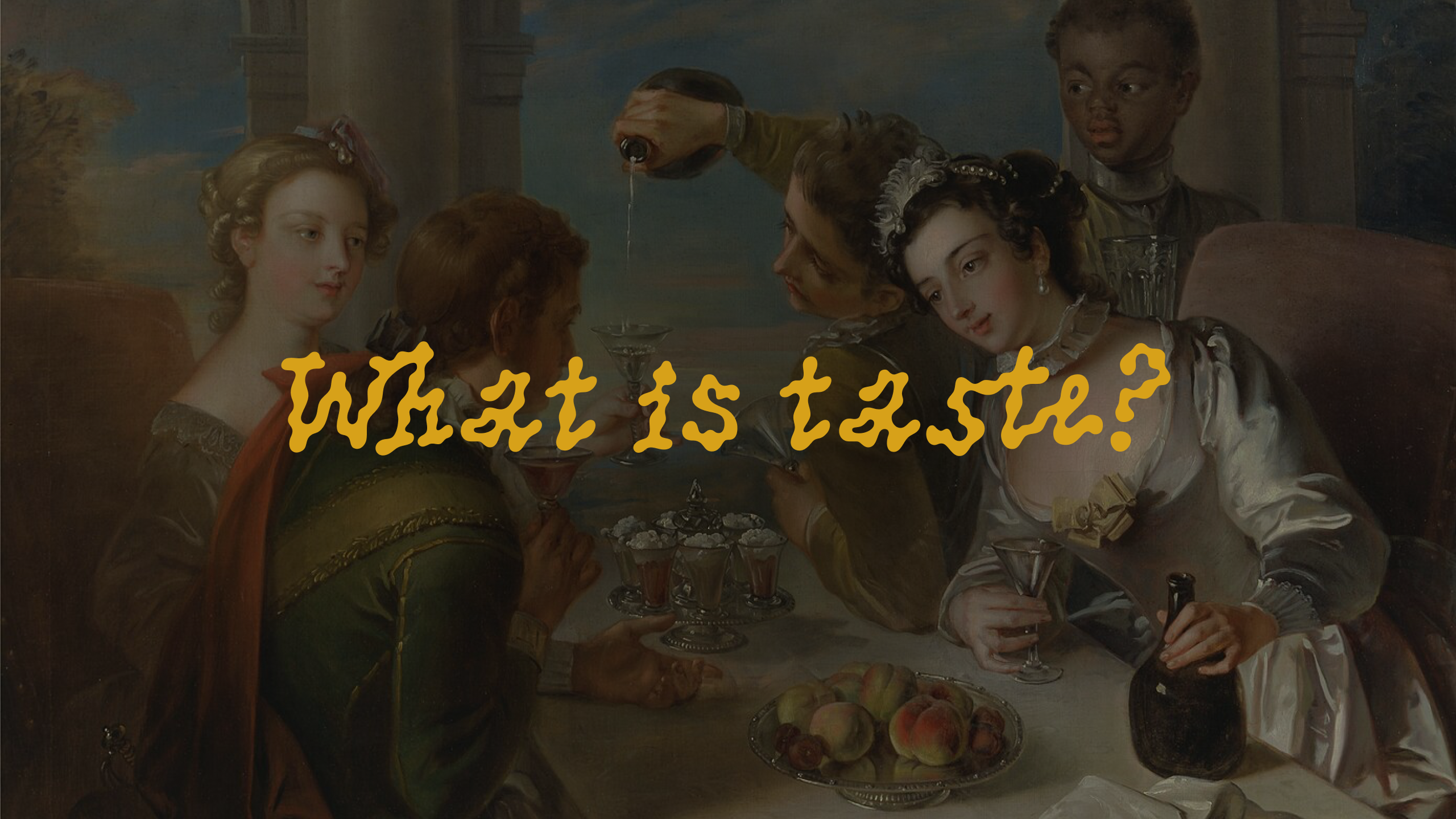
What is taste? Are you born with it or is it developed?
The other day I was listening to Cameron Worboys in a talk where he said that developing taste has become our strategic advantage as designers. It wasn't the first time I heard it. In recent months, I've heard many designers talking about the same thing: good taste has become a differentiator.
But what exactly is taste? Are you born with it or is it developed?
What is taste?
You probably already have an idea in your head of what taste is, and it's likely similar to the dictionary definition: "the ability to discern what is of good quality or of a high aesthetic standard."
But digging a little deeper, I found an essay by Scottish philosopher David Hume in which he reflects on good taste. In Of the Standard of Taste, Hume defines good taste as: "a strong sense, united to delicate sentiment, improved by practice, perfected by comparison, and cleared of all prejudice."
Strong sense, united to delicate sentiment, improved by practice, perfected by comparison, and cleared of all prejudice.
I particularly liked this definition because it presents taste as a capacity that combines the natural with the cultivated. For me, it's that feeling that tells you something is well made, arriving before words can explain it.
Are you born with it or is it developed?
Continuing with Hume's text, I found the answer to my next question: is taste something some fortunate people are born with, or can it be developed?
Hume answers: both. On one hand, he speaks of a strong sense and delicate sentiment, which seem more innate. But on the other hand, he talks about practice and comparison.
I think it's probably impossible to separate the two. Sensitivity without practice remains vague intuition, and practice without sensitivity becomes blind accumulation of references. Developing good taste requires curiosity, intention, and above all, patience. That's precisely why it becomes difficult to replicate.
Why is it so important now?
Practically every week a new AI tool launches that makes creation even easier. Today anyone can materialize an idea in seconds. But you've probably seen a poster and thought "this was made with ChatGPT": the same old typography, the same visual styles, the same artificial feel.

When everyone has access to the same tools and uses them similarly, the result is predictable: everything starts to look alike. And this is where taste makes the difference: it's what separates the generic from the memorable.
A clear example is the Liquid Glass visual language that Apple launched with iOS 26. You might find it horrible or brilliant, but what's clear is that behind it there's someone who dared to do things differently, with criteria and clear vision.

So, what am I going to do?
I truly believe we're living in an incredible and promising time for everyone with ideas and a desire to create. That's why it's more important than ever to keep cultivating our taste.
So:
I will keep seeking references and inspiration in the classics, in architecture, in painting, in nature.
I will keep paying attention to the details.
I will keep asking myself why something works or doesn't work.
And I will keep practicing, because practice makes perfect.
Creation has been democratized, but taste hasn't—at least not yet.